
You've brainstormed the perfect name. It captures your brand, rolls off the tongue, and feels right. You type it into a domain registrar with cautious optimism, and the result hits: taken. You try variations. Taken. Taken. Taken. Premium: $35,000.
After an hour of this, you start wondering if every good domain on the internet was claimed in 2005 and you're just picking through the scraps.
Here's the reality: you're not wrong that finding domains is harder than ever. With over 378 million registered domains globally, the obvious names are mostly gone. But "harder" doesn't mean impossible - it means you need better techniques than typing names into a search box and hoping for the best.

This guide isn't about understanding the availability problem - we covered that in our breakdown of the "available domain" myth. This is about solving it.
The Four-Option Framework
When your ideal .com is unavailable, you're facing a decision with four possible paths:
- Keep the name, use an alternative TLD - Register YourName.ai, YourName.io, or another extension
- Modify the name slightly - Add a prefix like "get" or "try" while keeping the core brand
- Pivot to a different name - Accept that this name isn't meant to be and find something better
- Buy the .com anyway - Negotiate with the current owner or pay the premium price
Each option has trade-offs. The right choice depends on your industry, budget, timeline, and how attached you are to the original name. Let's explore each path, then cover the techniques that actually work.
Option 1: Keep the Name, Choose an Alternative TLD
This has become the default strategy for tech startups - and the data supports it.
Analysis of over 4,000 Y Combinator and Techstars startups from 2020-2025 shows that alternative TLD usage has grown 50% in the past five years. By mid-2025, 54% of funded startups were using non-.com domains as their primary address. The .ai extension alone saw 300% growth, with 28% of accelerator-backed startups choosing it.
Why the shift? Alternative TLDs offer something .com often can't: exact brand name availability. Startups using alternative TLDs secured their exact brand name 85% of the time - compared to just 54% for those insisting on .com.
Industry-aligned TLDs that work:
- .ai - The standard for AI and machine learning companies. Major companies like x.ai and character.ai chose this path deliberately, not as a fallback.
- .io - Tech and developer-focused brands. Well-established in the startup world.
- .app - Mobile applications and software products.
- .co - A versatile alternative that reads as "company" in many minds.
- .dev - Developer tools and technical products.
When to avoid alternative TLDs:
- Consumer e-commerce: If you're selling physical products to mainstream consumers, .com still carries more trust.
- Local businesses: A plumber in Ohio doesn't need a .io domain.
- Industries where authority matters: Financial services, healthcare, and legal firms often benefit from .com's perceived stability.
Option 2: Modify the Name
If you're committed to .com but the exact name is taken, strategic modifications can work. The key is adding value, not just avoiding unavailability.
Action verb prefixes turn your domain into a call-to-action:
- get - GetNotion.com, GetSlack.com (many major brands use this officially)
- try - TryCanvas.com, TryFigma.com (implies low-commitment trial)
- use - UseStripe.com (direct instruction)
- join - JoinClubhouse.com (community-oriented)
- go - GoCanvas.com (action-oriented)
These prefixes aren't compromises - they're marketing. "GetYourBrand.com" tells visitors exactly what to do.
Important caveat: If you're using a prefix, the base name is taken by someone else. Make sure that someone isn't a direct competitor or a company you could be confused with.
What to avoid in modifications:
- Hyphens create confusion. Does "my-brand.com" have a hyphen? People will forget.
- Numbers that could be spelled out. Is it "4U.com" or "ForYou.com"?
- Double letters at word boundaries. "YourRide.com" - is that one R or two?
Option 3: Pivot to a Different Name
Sometimes the best move is accepting that your first-choice name isn't available and finding something better.
This feels like defeat, but it often isn't. The name you're attached to might not be the best name for your brand - you just encountered it first. Brandable names like Spotify, Notion, and Figma weren't anyone's first idea. They emerged from a process of iteration.
Signs you should pivot:
- The .com is owned by a competitor - sharing a name creates permanent confusion
- Modifications make it worse - if "GetYourBrand.com" sounds clunky, the base name might not be strong enough
- Multiple TLDs are unavailable - if .com, .ai, .io, and .co are all taken, the naming space is crowded
- You're forcing it - if you've spent a week trying to make one name work, sunk cost fallacy is talking
How to pivot effectively:
- Identify what you liked about the original name - was it the sound, the meaning, the length?
- Generate many alternatives - aim for 30-50 candidates, not 5
- Check availability upfront - no point falling in love with another taken name
- Score candidates objectively - use consistent criteria like verbal clarity, brand fit, and SEO potential
Option 4: Buy the .com Anyway
Sometimes paying the premium is the right call. Domain ownership is an investment, not just an expense.
When buying makes sense:
- You're well-funded and the domain is a rounding error in your budget
- The name is central to your brand (think "Stripe" or "Square")
- You're planning a long-term build that justifies the investment
When buying doesn't make sense:
- Pre-revenue or bootstrapped with limited runway
- The owner wants unreasonable amounts ($100,000+ for generic names)
- Alternatives are perfectly good - if YourBrand.ai is available for $50, why pay $15,000 for the .com?
Negotiation tips:
- Start at 30-50% of asking price - most listed prices are negotiable
- Be patient - domain negotiations can take weeks
- Use a broker to maintain anonymity and often get better prices
- Set a firm maximum before you start
Why Traditional Domain Searching Fails
Most people approach domain search like this:
- Think of a name
- Check if the .com is available
- It's not
- Add words, numbers, or hyphens
- Get frustrated
- Settle for something mediocre
This sequential, single-TLD approach is why founders spend days on something that should take minutes. You're playing a game where the rules almost guarantee you lose.
The winning approach flips this entirely: generate many options, check multiple TLDs simultaneously, and score candidates objectively rather than guessing which compromises are acceptable.
Technique 1: Generate Brandable Names, Not Keyword Mashups
Traditional domain generators take your keywords and mash them together: "FastDeliveryHub," "QuickShipPro," "DeliveryNowOnline." These names are generic, forgettable, and usually still taken because thousands of other people had the same obvious idea.
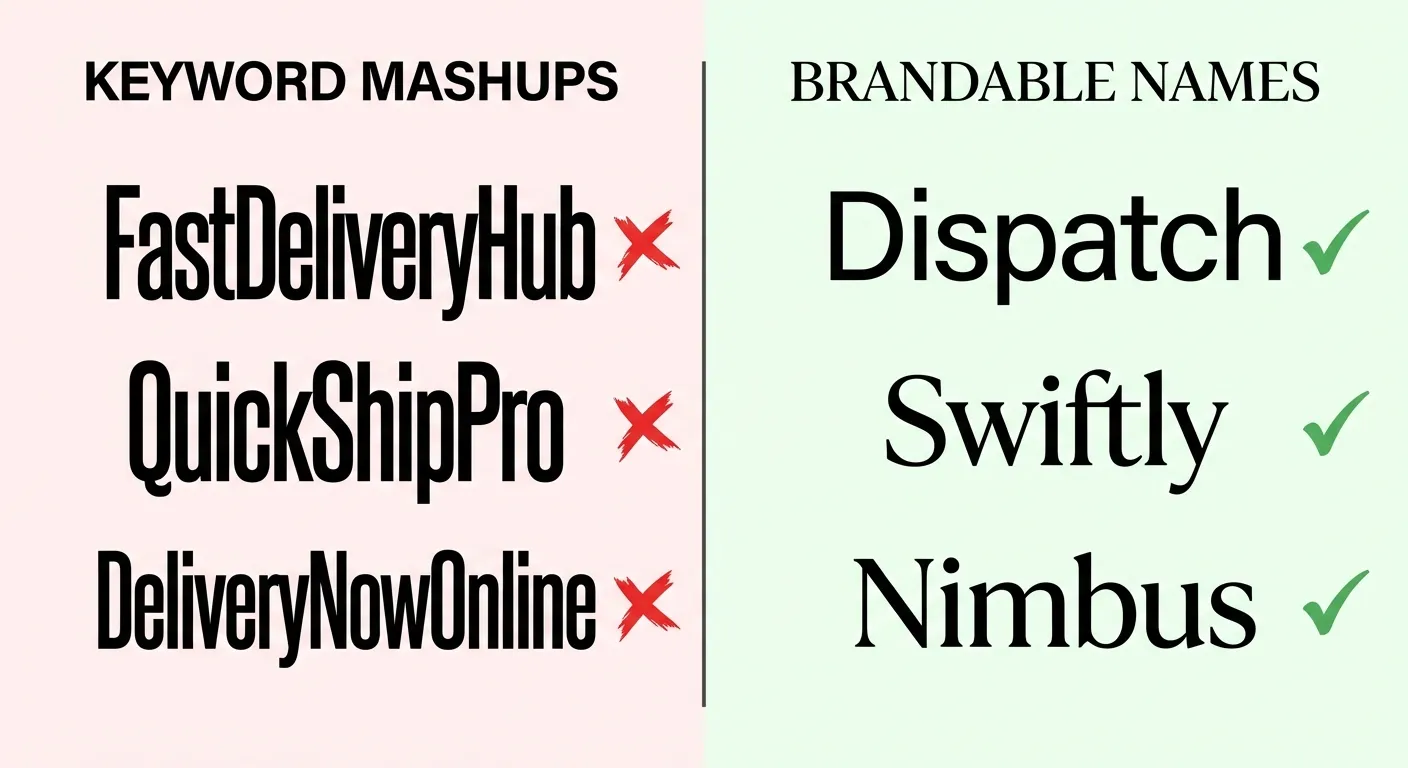
Brandable names work differently. They're invented or repurposed words that become associated with your product - think "Stripe," "Notion," "Figma," or "Slack." None of these names describe what the product does. They became meaningful because of the product.
Approaches for creating brandable names:
- Invented words - Combine sounds that feel right. "Spotify" is "spot" + "identify" compressed.
- Repurposed common words - "Slack," "Notion," "Apple," and "Amazon" are common words used outside their dictionary meaning.
- Modified spellings - "Lyft" instead of "Lift." Be careful - you'll lose traffic to the correctly-spelled version.
- Word blends - "Pinterest" (pin + interest), "Instagram" (instant + telegram).
Technique 2: Check Availability Across Multiple TLDs Simultaneously
Checking domains one at a time is the slowest possible approach. Modern domain search should give you a matrix:
| Name | .com | .ai | .io | .app | .co |
|---|---|---|---|---|---|
| BrandName | $35,000 | $50 | $40 | $15 | $30 |
Suddenly you see options. The .com is premium-priced, but three alternatives are available at standard rates. This comparison lets you make strategic decisions instead of binary yes/no reactions.
We built URLGenie specifically to solve this - checking real availability across multiple TLDs with actual pricing, not just "available" flags that turn into premium listings at checkout.
Technique 3: Apply the Radio Test Before You Commit
Before falling in love with any name, run it through the radio test: if someone heard this domain spoken aloud, could they spell it correctly on the first try?
Names that pass:
- Clear pronunciation with obvious spelling
- No homophones (words that sound like other words)
- No ambiguous letter combinations
Names that fail:
- Intentional misspellings ("Flickr" requires explanation)
- Numbers that could be spelled out ("4U" vs "ForYou")
- Silent letters or unusual letter combinations
- Hyphens (does "my-brand" have a dash? where?)
A name that fails the radio test will cost you traffic forever. Every time you say your domain out loud - in podcast interviews, at conferences, on the phone - some percentage of listeners will type it wrong.
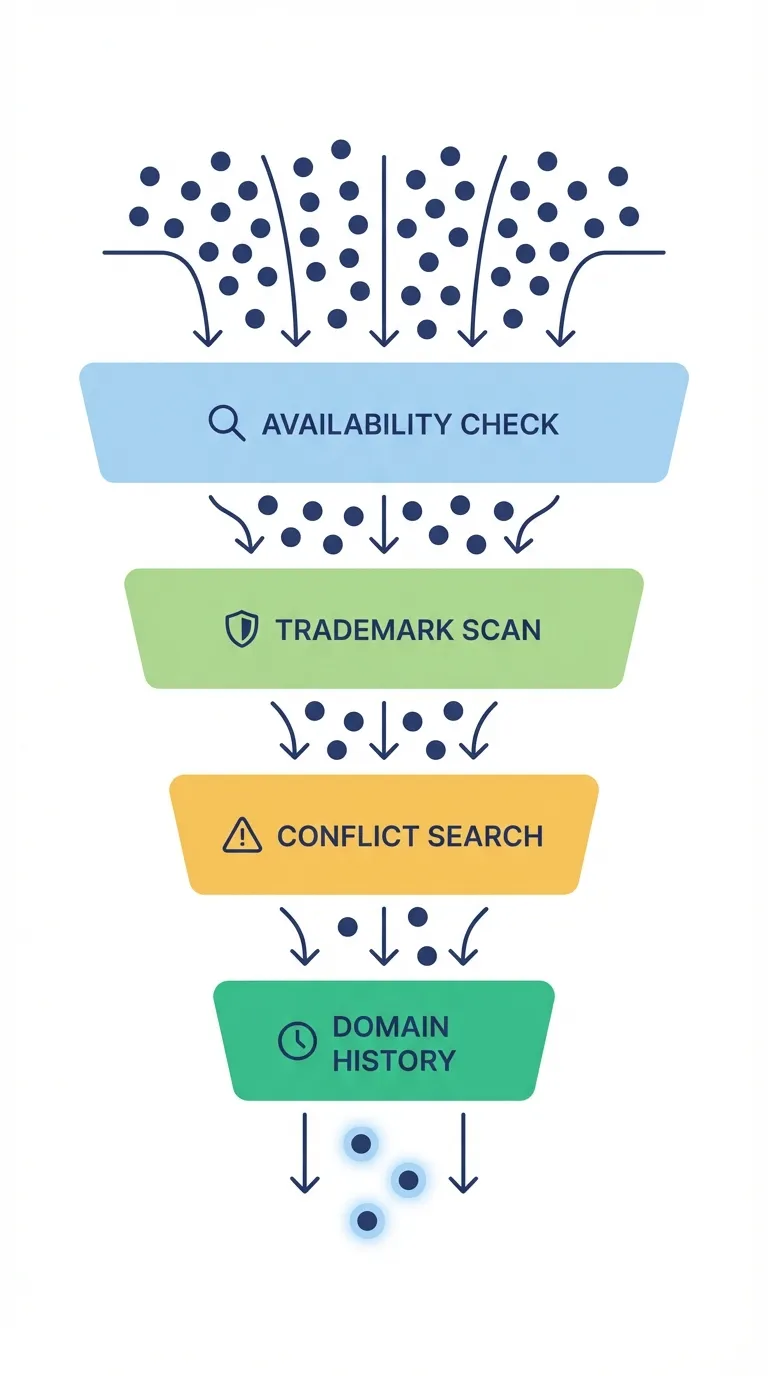
Technique 4: Run Background Checks Before Registration
A domain being available doesn't mean it's safe to use. Before you register, check for:
Trademark conflicts: Search the USPTO database (for US) or equivalent for your target markets. A domain might be available because no one's wanted to use it - or because it's too similar to an existing trademark. We explained the full risk landscape in our guide to trademark and brand risk.
Confusingly similar businesses: Google the name. Are there companies operating with similar names in adjacent spaces? Even without trademark issues, customer confusion hurts both parties.
Negative associations: Does the name sound like something offensive in another language? Does it have unfortunate letter combinations when read as a single string? ("PenIsland" and "TherapistFinder" are classic cautionary tales.)
Domain history: Some domains were previously registered and used for spam, phishing, or other activities that got them blacklisted. Tools like the Wayback Machine can show what a domain was previously used for.
Technique 5: Generate Many Options, Then Score Them
The difference between spending five days on domain search and spending five minutes is volume and objectivity.
Instead of evaluating names one at a time with gut instinct, generate 30-50 candidates and score them against consistent criteria. As we outlined in our complete naming guide, good domain names should be evaluated on:
- Brand Fit - Does it align with what you're building?
- Verbal Clarity - Can people spell it after hearing it?
- Authority - Does it sound trustworthy?
- SEO Potential - Will it help or hurt search visibility?
- Availability and Cost - What TLDs are available at what prices?
When you have 50 options scored across these dimensions, the best choices become obvious. You're not guessing anymore - you're comparing data.
Making the Decision
Here's a quick framework for choosing between the four options:
Choose an alternative TLD if:
- You're in tech, AI, or software
- Your audience understands and accepts alternative extensions
- The alternative TLD actually adds meaning (like .ai for an AI product)
Modify the name if:
- The modification sounds natural and adds value
- The base name's current owner isn't a competitor
- You're committed to .com for trust reasons
Pivot to a new name if:
- Modifications feel forced
- Multiple variations are unavailable
- You've been stuck on this name for more than a few days
Buy the premium .com if:
- You have the budget
- The name is core to your identity
- Long-term brand value justifies the cost
Stop Searching, Start Deciding
The goal isn't to search for domains forever. It's to find a domain you're confident in and move on to building your business.
The mistake most founders make isn't choosing the wrong option - it's spending too long deciding. Days or weeks spent debating "should I use .ai or try a different name?" are days not spent building your product.
The techniques in this article work because they change the game: from linear trial-and-error to parallel generation and evaluation. You're not hoping to get lucky - you're systematically surfacing the best available options.
If you're stuck after applying these methods manually, the bottleneck is probably volume. Checking 10 names across 2 TLDs gives you 20 data points. Checking 50 names across 6 TLDs gives you 300.
That's what URLGenie automates: generating brandable candidates, checking real availability across multiple TLDs, scoring against brand metrics, and flagging risks - all in about five minutes.
Your perfect domain is out there. Pick a path, register the domain, and get back to building.