
You've got the perfect business name. You type it into a domain registrar with your fingers crossed. The search spins for a second, then delivers the verdict: "Available!"
Your heart jumps. This is it. You click through to register, and then you see it: $45,000.
Wait, what?
Welcome to the "available domain" myth—the gap between what founders think domain availability means and what it actually means in 2026. Over 378 million domains are registered globally, and if you're searching for a good .com, you're not just competing with active websites. You're up against parking pages, domain squatters, and aftermarket speculators who got there first.
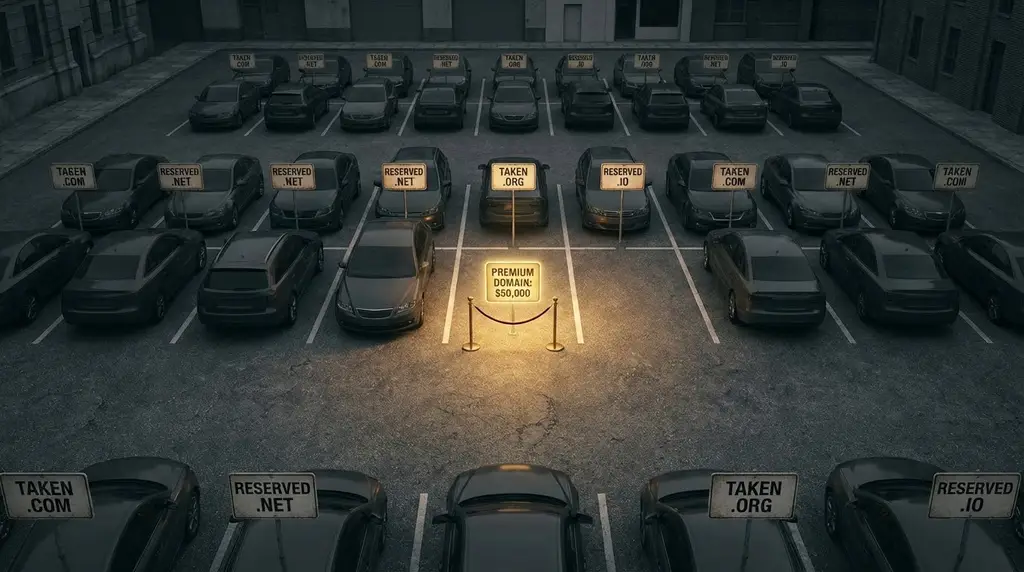
The Harsh Reality of .com Scarcity
Let's start with the numbers. As of Q3 2025, there are 378.5 million domain registrations worldwide. The .com extension alone holds approximately 160 million of those registrations—and that number has been climbing steadily for over two decades.
Here's what most founders don't realize: "available" doesn't mean what you think it means.
When you search for a domain and see it listed as "available," one of three things is usually true:
- It's parked or squatted - Someone registered it years ago and is holding it, hoping you'll pay a premium
- It's listed on an aftermarket platform - The domain is technically for sale, but at prices ranging from $5,000 to $500,000+
- It has trademark or similarity conflicts - The domain is unregistered but carries hidden legal risks
Very rarely does "available" actually mean "available for $10-$15 with zero baggage."
What You Think vs. What You Get
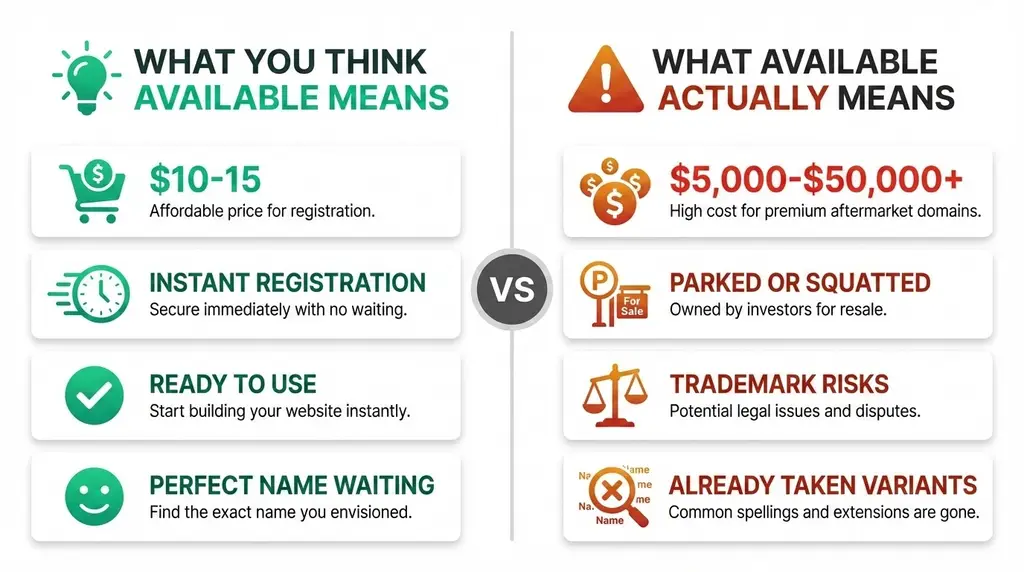
The disconnect between expectation and reality costs founders days—sometimes weeks—of wasted research time. You start with optimism, thinking you'll find a solid .com in an afternoon. You end up three days later with a spreadsheet of crossed-out names and mounting frustration.
I've been there. When we were naming URLGenie, we tried the traditional approach first: brainstorming names, checking one by one, hitting dead ends. Every "good" name was either taken, parked with a $20,000 price tag, or uncomfortably similar to an existing brand.
The process that should take an hour stretches into a multi-day slog. You start compromising—adding extra words, using weird spellings, considering names you don't actually like. And even then, you're not sure if you're making the right call or just settling for what's left.
The Domain Squatting Problem Is Getting Worse
Domain squatting—registering domains with the intent to resell them at inflated prices—isn't a fringe issue. It's an industry.
According to the World Intellectual Property Organization (WIPO), 6,192 cybersquatting cases were filed in 2023—a 68% increase since the start of COVID. And that trend continued into 2025, with domain disputes rising nearly 10% in Q3 alone.
These aren't just trademark violations. Many squatters operate in a legal gray area, registering generic or brandable names that aren't trademarked yet. They park the domain with a "Make an Offer" page and wait for someone desperate enough to pay.
The aftermarket domain industry is projected to grow from $2.4 billion USD in 2025 to $4.7 billion USD by 2032. That's not driven by legitimate resale of used domains—it's fueled by speculation. Investors register hundreds or thousands of domains, betting that a fraction will sell at massive markups.
For founders, this means the odds of finding an unregistered, high-quality .com are lower than ever. The good names were claimed years ago, and now they're sitting behind paywalls.
When "Available" Means $50,000
Here's how the premium domain trap works.
You search for a name. The registrar says it's "available." You click to register, and suddenly you're redirected to a marketplace listing showing:
- Make an Offer - Translation: "Start the bidding at $10,000"
- Buy Now: $35,000 - A "discounted" price from the owner's imaginary $100,000 valuation
- Premium Listing - The domain has been flagged by the registrar as "valuable" and is priced accordingly
These aren't anomalies. Premium domain pricing has become standard practice. Registrars and aftermarket platforms analyze domains based on length, keywords, and perceived commercial value, then mark them up accordingly.
Even domains that seem obscure can carry shockingly high price tags. A seven-letter .com with no obvious brand value might be listed at $8,000 simply because it's short and pronounceable. A two-word combination with moderate search volume could be priced at $25,000 or more.
For a bootstrapped founder or early-stage startup, these prices are non-starters. You're not going to spend your seed funding on a domain when you haven't even validated product-market fit yet.
The Hidden Cost: Time and Opportunity
Let's talk about what all this searching actually costs.
Say you spend three hours per day over five days trying to find a domain manually. That's 15 hours of founder time—time you could have spent talking to customers, building your MVP, or closing your first sales.
If you value your time at even $50/hour (a conservative estimate for founder opportunity cost), that's $750 in lost productivity. And that's assuming you actually find a name you're happy with. Many founders end up cycling through this process multiple times, restarting from scratch when nothing clicks.
Then there's the psychological toll. The constant rejection wears you down. You start second-guessing your original vision. Maybe the name doesn't matter that much? Maybe you should just pick something "good enough"?
But here's the truth: your domain name does matter. It's your first impression, your brand anchor, and a key factor in whether customers remember you or forget you five minutes later. Settling for a mediocre name because the process broke you is a decision you'll regret later.
Why Alternatives to .com Are Gaining Ground
Faced with .com scarcity and premium pricing, many founders are turning to alternative TLDs (top-level domains). And the data shows this isn't just a trend—it's a strategic shift.
Analysis of over 4,000 startups from Y Combinator and Techstars (2020-2025) reveals that nTLD usage has grown 50% in the past five years. Extensions like .ai, .io, .app, and .pro are no longer seen as second-tier options—they're legitimate choices, especially for tech startups.
Here's why:
1. Availability
While .com domains are saturated, alternative TLDs still have plenty of brandable names available at standard registration prices ($10-$20/year).
2. Industry Alignment
A .ai domain signals that you're an AI company. A .io domain has become synonymous with tech startups. These TLDs aren't generic—they communicate what you do before users even visit your site.
3. Memorability
In some cases, a creative alternative TLD is more memorable than a compromised .com. Would you rather be "BetterNameAI.com" or "BetterName.ai"? The latter is cleaner and more aligned with your brand.
4. Cost Efficiency
Why spend $30,000 on a mediocre .com when you can get a great .ai domain for $50? For early-stage startups, that capital is better spent on customer acquisition or product development.
That said, .com still carries authority, especially for e-commerce brands and non-tech businesses. The key is understanding when .com matters and when it doesn't.
The Multi-TLD Strategy: Stop Betting on One Extension
The biggest mistake founders make is limiting their search to .com only.
In 2026, the smart approach is a multi-TLD strategy: brainstorm names, then check availability across multiple extensions simultaneously. You might find that:
- YourName.com is parked at $40,000
- YourName.ai is available for $50
- YourName.io is available for $35
- YourName.app is available for $15
Suddenly, you have options. You can choose the TLD that best fits your industry, budget, and brand positioning—instead of being held hostage by .com scarcity.
This is exactly the approach URLGenie automates. Instead of checking domains one by one, you get availability data across multiple TLDs in a single report, with scoring and recommendations to help you make the right call.

How to Navigate the Availability Minefield
If you're in the middle of naming your startup and hitting these availability roadblocks, here's what to do:
1. Stop Checking .com Only
Expand your search to include .ai, .io, .app, .co, and other relevant TLDs. You'll instantly open up thousands of available options.
2. Use Real Availability Checking Tools
Don't rely on manual one-by-one searches. Use tools that check multiple TLDs at once and show real pricing (not just "available" flags that turn into premium listings).
3. Run Background Checks for Conflicts
Before you fall in love with a name, make sure it's not confusingly similar to an existing brand. A domain might be technically available but carry hidden trademark risks.
4. Don't Settle Too Early
Resist the urge to grab the first mediocre name you find. If you're not confident in the name after three days of searching, you won't be confident in it after three years of building your brand.
5. Consider Strategic Compromises
If your ideal .com is parked at $50,000, ask yourself: Is that specific domain worth the cost, or would a strong alternative TLD serve you just as well?
The Real Solution: Stop Guessing, Start Scoring
The fundamental problem with traditional domain search isn't just scarcity—it's the lack of data.
When you manually search for domains, you're making subjective calls based on gut feeling. You don't know if a name is brandable, easy to spell, or likely to rank well in search. You're just guessing.
What if, instead of guessing, you had a system that:
- Generated dozens of brandable name options
- Checked real availability across multiple TLDs
- Scored each name based on clarity, authority, SEO potential, and resale value
- Flagged early warning signs like similar businesses or negative associations
That's the difference between spending five days on a name you're unsure about and spending five minutes on a name you're confident in.
When we were naming URLGenie, we tested this exact approach. We ran our own tool, generated over 200 candidates, and URLGenie.ai came back ranked #1 with a 98/100 score. It was available, had no risk signals, and we registered it immediately. We were so confident in the top results that we registered all three of the highest-scoring domains.
That's what data-driven naming looks like.
Moving Forward: What Founders Should Know
Here's the bottom line: the "available domain" myth is costing you time, money, and confidence. The traditional process is broken, and .com scarcity isn't going away.
But there is a better way. By expanding your search to alternative TLDs, using real-time availability checking, and applying objective scoring to your options, you can find a great domain in minutes—not days.
The goal isn't to settle for what's left. It's to make a confident, data-backed decision that positions your brand for long-term success.
If you're stuck in the domain availability trap right now—staring at spreadsheets of crossed-out names and $40,000 parking pages—there's a faster path forward. Stop checking domains one by one. Start checking them all at once, with real data and clear recommendations.
That's what URLGenie was built to do. And if you want to see how different the process feels when you have the right tools, try it now—you'll have ranked results with multi-TLD availability in about five minutes.
Because your domain name matters. But spending five days searching for it? That doesn't.