
Choosing a business name is one of the most consequential decisions you'll make as an entrepreneur. Your name is your first impression, your brand foundation, and a critical asset that will either open doors or create friction for years to come.
Yet most founders approach naming like a guessing game. They brainstorm a few options, check if the .com is available, and hope for the best. This guide provides a complete framework for naming your business - one that works whether you're launching a tech startup, opening a food truck, or starting a consulting practice.

Table of Contents
- The Five Scoring Criteria
- Industry-Specific Priorities
- The Naming Framework: 5 Steps That Work
- Common Naming Mistakes
- When to DIY vs. Hire a Branding Agency
- Final Thoughts
The Five Scoring Criteria: How to Evaluate Any Name
Before diving into the naming process, you need objective criteria to compare options. Professional branding agencies (and tools like URLGenie) evaluate every name against five metrics, each weighted equally at 20%.
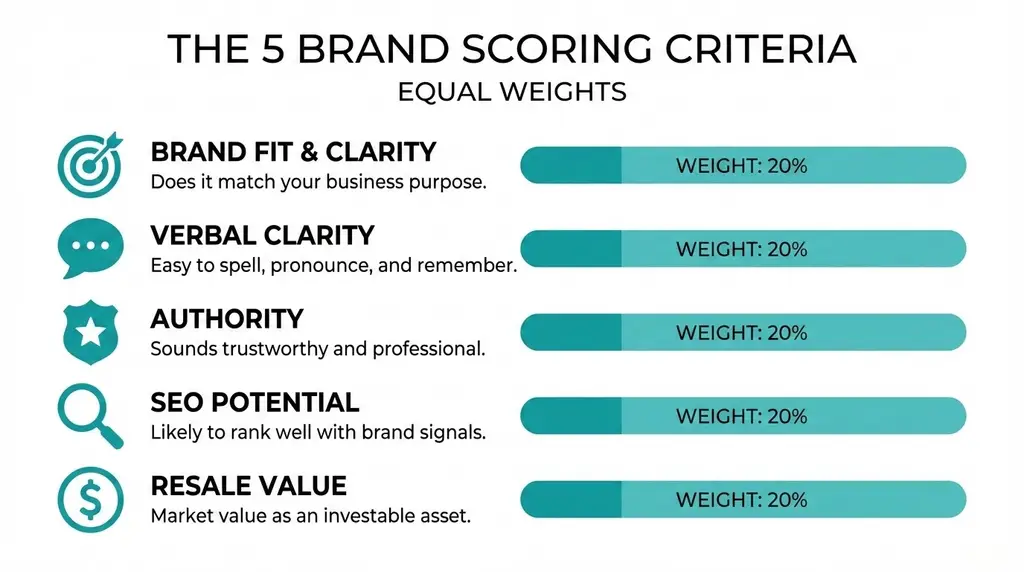
1. Brand Fit & Clarity (20%)
What it measures: How well the name aligns with your business positioning and communicates your purpose.
Strong brand fit reduces marketing costs. If your name instantly signals what you do or who you serve, you spend less explaining yourself. "URLGenie" scores 9.5/10 because "URL" signals the category and "Genie" implies magical problem-solving.
2. Verbal Clarity (20%)
What it measures: Can people spell, pronounce, and remember your name after one exposure?
This is called "the radio test" - imagine saying your name once on a podcast. Could the listener spell it correctly to search for you later? Names like "Sweetgreen" score 9/10 because both words are common and spelled exactly as expected. Names like "Fiverr" create friction because they require explanation.
3. Authority (20%)
What it measures: Does the name sound credible, professional, and trustworthy to your target audience?
Names carry implicit signals about quality. The wrong name can cost you customers even if your product is excellent. A .com domain generally scores higher on authority than alternative TLDs, especially in traditional industries.
4. SEO Potential (20%)
What it measures: Likelihood the name will help (or hurt) your organic search visibility.
While exact-match domains no longer guarantee rankings, brandable names with strong signals often outperform generic keyword names. "Notion" scores 8.5/10 because it's unique and now owns the top search results despite being a common word.
5. Resale Value (20%)
What it measures: Estimated market value of the domain as an investable asset.
Your domain is an asset that can appreciate. Short, clear names on premium TLDs (.com, .ai) have higher resale value. Value drivers include length, TLD quality, clarity, and category flexibility.
Industry-Specific Priorities: What Matters Most in Your Space
While all five criteria matter, different industries weight them differently in practice. A name that works brilliantly for a tech startup might fail for a local food business.
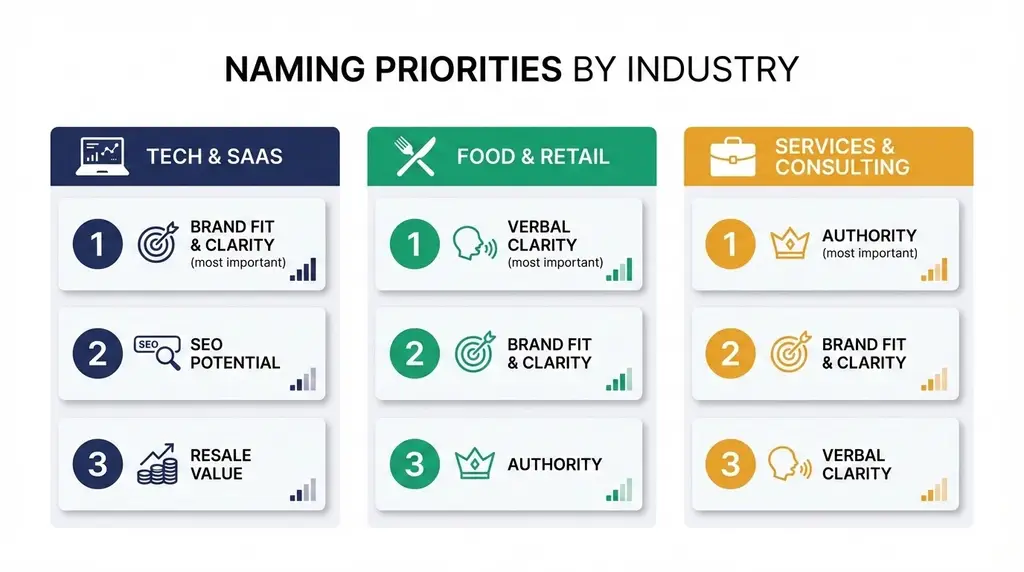
Tech & SaaS
Prioritize: Brand Fit & Clarity, SEO Potential, Resale Value
Short, memorable names with tech-forward signals work best (Stripe, Notion, Figma). Abstract brandable names often outperform descriptive ones because they allow for expansion. Premium domains matter because investors and customers judge legitimacy by your domain.
Avoid: Overly cutesy misspellings that create typing friction. Keyword-stuffed names that sound spammy.
TLD strategy: .com is preferred but .ai and .io are increasingly acceptable for tech audiences.
For detailed strategies on naming tech companies, see our complete guide to choosing a startup domain.
Food & Retail
Prioritize: Verbal Clarity, Brand Fit & Clarity, Authority
Customers need to spell your name to search for you on Google Maps or tell friends. Clear, pronounceable names with sensory or emotional connections work best (Sweetgreen, Bluestone Lane).
Avoid: Complicated spellings that fail the radio test. Overly generic names that make you invisible in local search.
TLD strategy: .com is king for local businesses. Alternative TLDs can work for specialty brands but test whether your audience understands them.
The same scoring criteria apply - just weight verbal clarity higher since customers need to find you on Google Maps.
Services & Consulting
Prioritize: Authority, Brand Fit & Clarity, Verbal Clarity
Your name needs to signal expertise and professionalism. Names that communicate expertise without being overly formal work well (McKinsey, Bain). Personal brand names with descriptive modifiers also work.
Avoid: Overly creative or playful names that undermine credibility. Generic acronyms that lack personality.
TLD strategy: .com is expected in professional services. Alternative TLDs can work for specialized niches, but err on the side of tradition.
Authority matters most here - your name needs to signal expertise before clients even speak to you.
The Naming Framework: 5 Steps That Work
Every successful naming process follows the same core workflow. Here's how to execute it efficiently.
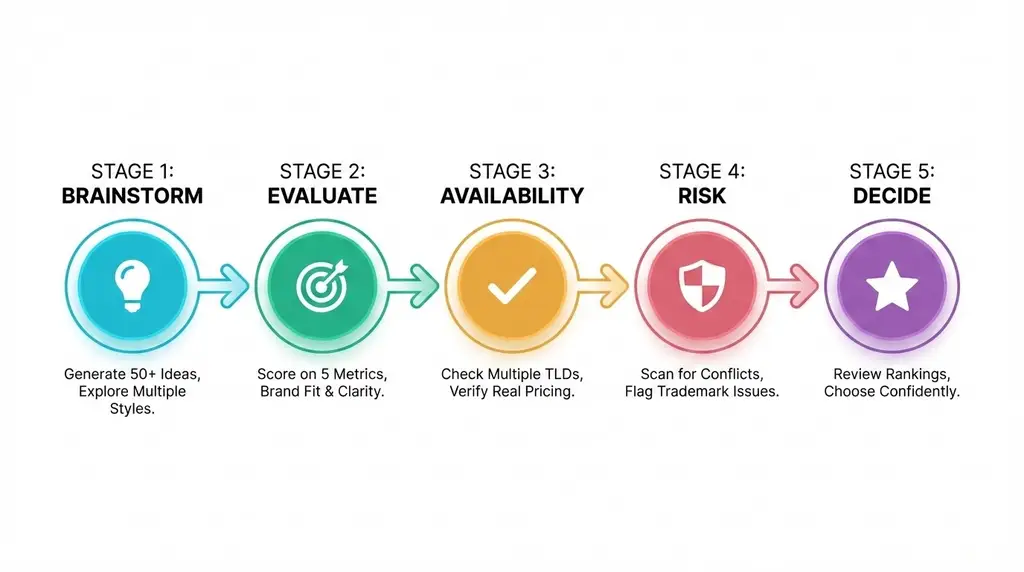
Step 1: Strategic Brainstorming
Before generating any names, define your positioning. What does your business actually do? Who is your target audience? What naming style fits your brand - descriptive (QuickBooks), abstract (Stripe), or creative (Mailchimp)?
Generate volume, not just a handful of options. Professional naming projects typically generate 50-200 candidates before narrowing down. You need quantity to find quality.
Step 2: Evaluate Against the Five Criteria
Score each candidate against Brand Fit & Clarity, Verbal Clarity, Authority, SEO Potential, and Resale Value. This systematic approach replaces gut feeling with objective comparison.
BigCommerce's 2025 naming guidelines found that businesses using structured evaluation frameworks made final name decisions 64% faster than those relying purely on subjective preference.
Step 3: Check Real Availability
This is where most DIY naming efforts break down. Don't check domains one at a time - use batch availability checkers that verify multiple TLDs simultaneously.
Consider TLD strategy based on your industry:
- .com remains the gold standard for e-commerce and traditional industries
- .ai is gaining credibility for AI-focused startups
- .io works well for SaaS and developer tools
- Industry-specific TLDs (.food, .tech, .app) can work if they directly reinforce your positioning
As we covered in our guide to choosing a domain name for your startup, the TLD you choose sends a signal about your business.
Step 4: Scan for Risk Signals
This is the step most founders skip - and it's how you end up in legal trouble.
Check for confusingly similar businesses (even unregistered names can create legal issues), negative brand associations, and domain history issues. According to Wolters Kluwer's business naming legal guide, 37% of small businesses discover trademark conflicts after they've already launched.
Professional trademark searches can cost $500-$2,000 per name. Tools like URLGenie provide automated risk scanning to flag obvious conflicts early - not a replacement for legal advice, but useful for avoiding wasted time on names with clear red flags.
Step 5: Make Your Decision
By this stage, you should have 3-5 strong candidates that score well, have real availability, and show no major risk signals.
How to choose between finalists:
- Test them with 5-10 people in your target audience. Can they spell it back correctly?
- Check for longevity. Will this name still work if you pivot or expand?
- Trust the data. If one name consistently scores higher, don't override it just because another "feels" better.
Common Naming Mistakes (And How to Avoid Them)
Even with a solid framework, founders still make predictable mistakes.
Mistake #1: Falling in Love Before Checking Availability
You brainstorm for hours, finally land on "the one," then discover the .com is taken or costs $50,000. The fix: Check availability during brainstorming, not after.
Mistake #2: Choosing a Name That's Too Narrow
You name your business "Denver Vegan Meal Prep" and then want to expand to Boulder or add non-vegan options. Now your name is a cage. The fix: Think 3-5 years ahead. Overly specific names are one of the most expensive mistakes startups make - choose something with room to grow.
Mistake #3: Ignoring Spelling Friction
You choose a clever misspelling thinking it's creative, but customers constantly misspell it when searching for you. The fix: Test every finalist by saying it out loud to 5-10 people. If more than two get it wrong, reconsider the name.
Mistake #4: Skipping Risk Assessment
You launch with a name, then discover a similar business exists, or worse - a trademark conflict forces a rebrand. The fix: Always scan for confusingly similar businesses before registering.
Mistake #5: Letting Domain Availability Dictate Your Name
You find a great name, but the .com is taken. So you settle for a mediocre name just because the .com is available. The fix: If the perfect name exists on a different TLD (.ai, .io, .app), that might be a better choice than a compromised name on .com.
When to DIY vs. Hire a Branding Agency
Not every business needs a $20,000 agency naming project.
DIY works best for: Pre-seed startups on tight budgets, MVPs where speed matters, founders comfortable with brand strategy who just need execution support, and businesses in straightforward categories without complex trademark landscapes.
Hire an agency when: You're an established company rebranding, you face complex trademark landscapes requiring deep legal diligence, you need comprehensive brand strategy beyond just a name, or you have the budget ($15K-$50K+) and timeline (6-12 weeks).
The hybrid approach: Many founders use AI tools to generate and evaluate hundreds of candidates, then hire a trademark attorney to vet the top 3-5 finalists. This costs $1,000-$2,000 instead of $20,000. For a detailed cost-benefit comparison, see our analysis of agencies vs. AI tools.
Final Thoughts
Choosing a business name doesn't have to feel like rolling the dice. With a structured framework, objective evaluation criteria, and the right tools, you can make a confident, data-backed decision.
The businesses that win aren't the ones with the most creative names - they're the ones that choose strategically, move quickly, and avoid costly mistakes.
Whether you're naming a tech startup, a local food business, or a professional services firm, this framework works. Adapt the priorities to your industry, but don't skip the core steps: brainstorm volume, evaluate systematically, check real availability, scan for risks, and decide with confidence.
Your name is one of your most valuable assets. Choose it like one.
Ready to find your perfect business name? URLGenie generates 50+ brandable domain ideas, checks real availability, scores every name, and flags risk signals - all in about 5 minutes.