
Your domain name might be your most expensive mistake - and you'd never know it. Unlike a broken feature or a bad ad campaign, a weak domain name doesn't generate error messages or angry emails. It just quietly bleeds customers.
The damage shows up in metrics you blame on other things: low click-through rates, poor word-of-mouth, high bounce rates, zero branded search volume. Here are ten red flags that your domain is the problem. Check your own name against each one.
1. You Have to Spell It Out Every Time
Say your domain name to someone right now. Not show them - say it out loud. Can they type it correctly on the first try?
If you find yourself saying "it's B-R-I-T-E not B-R-I-G-H-T" or "there's a hyphen between the words" or "it's the number 4 not the word four," you're leaking customers every single day. Every podcast mention, phone call, or word-of-mouth referral becomes a game of telephone where your URL gets lost in translation.
This is the "radio test," and failing it has measurable consequences for your brand's verbal clarity. If people can't spell your domain after hearing it once, some percentage of them will never find you.
2. Your Domain Describes Your Category, Not Your Brand
Domains like "BestCloudSolutions.io" or "FastDeliveryHub.com" feel safe because they describe the business. But as we covered in our piece on why keyword mashing kills brands, they create three specific problems:
- Nobody searches for you by name. Google treats branded search volume as a trust signal. If your domain is a generic phrase, nobody Googles "BestCloudSolutions" specifically - they search "cloud solutions," where you're one result among thousands.
- You can't own it. You'll never rank first for "best cloud solutions" because that's a category, not a brand. And you can't trademark a generic descriptor.
- It signals amateur. Experienced buyers see keyword-stuffed domains the way they see clip-art business cards - as a sign that the business isn't serious.
3. People Confuse You With a Similar Domain
If there's a company at "yourname.com" and you're at "yourname.io" - or vice versa - you're sharing customers whether you like it or not. This happens constantly:
- Type-in traffic goes to the wrong site
- Customers email the wrong address
- Referrals land on your competitor
- Search engines struggle with entity disambiguation
The closer your domain is to an existing business, the more traffic you silently lose. And if the similar domain hosts low-quality content or something problematic, their reputation bleeds into yours.
4. Your Click-Through Rate Is Low Despite Decent Rankings
You're on page one of Google, but you're getting fewer clicks than your position should earn. Before you blame your meta descriptions, look at your URL in the search results.
Users make split-second trust decisions based on the domain they see. A brandable name like "Stripe" or "Notion" signals legitimacy. A keyword-stuffed domain like "QuickPaymentProcessorOnline.com" signals spam - or at best, a directory site nobody trusts with their credit card.
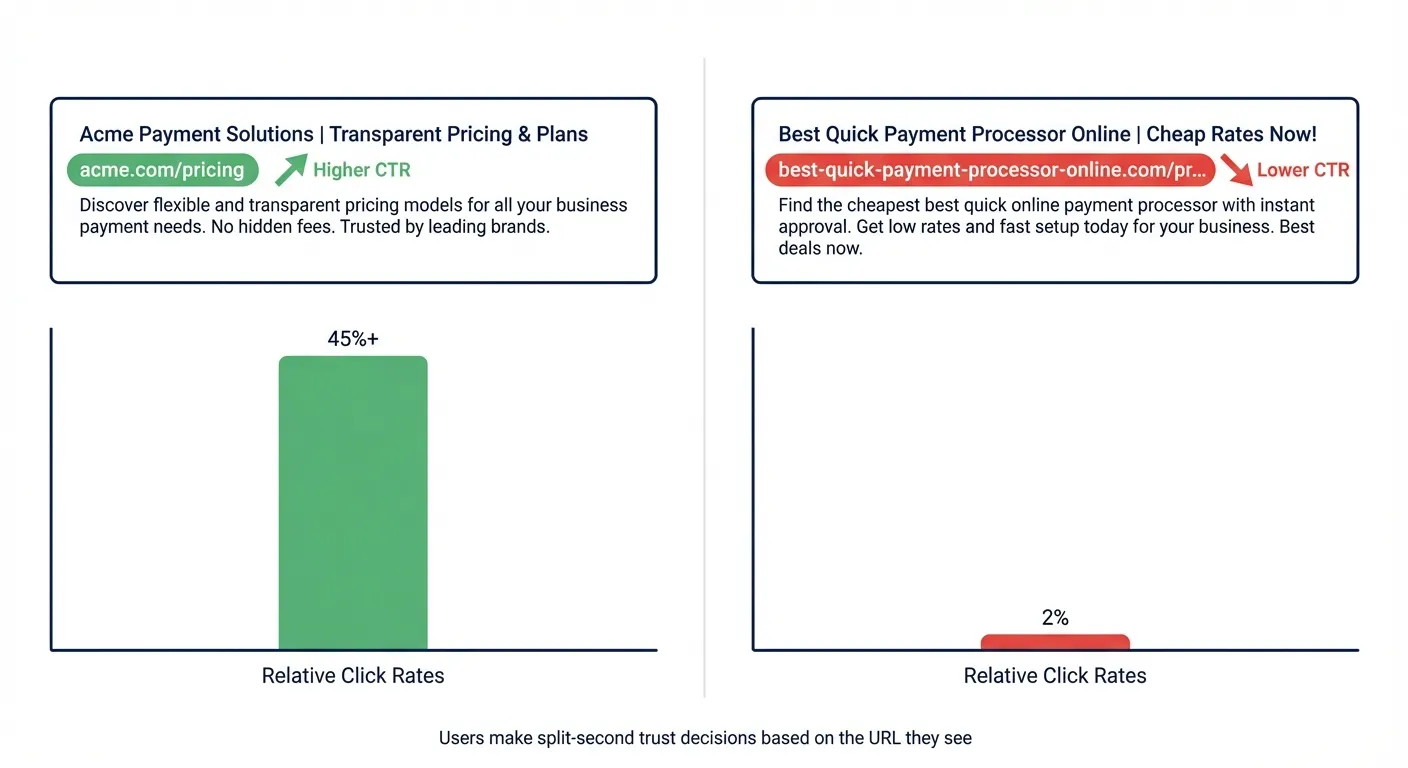
If your domain looks generic or suspicious in search results, you're paying for rankings but not getting the clicks you've earned.
5. Nobody Searches for You by Name
Open Google Search Console. Look at your branded search queries - searches that include your exact business name. If that number is close to zero, your domain has a brand recognition problem.
Branded search volume is one of the strongest trust signals Google uses. When people search for you by name, it tells Google you're a real business that real people care about. A distinctive, memorable domain generates branded searches naturally. A generic domain doesn't.
This isn't just about SEO vanity metrics. Low branded search means low direct traffic, weak word-of-mouth, and a brand that people can't find when they want to come back.
6. Your Domain Contains Hyphens or Numbers
Hyphens and numbers create confusion in every context:
- Spoken: "Is it dash or hyphen? Do I spell out 'four' or use the number?"
- Typed: People forget the hyphens and end up on a different site
- Perceived: Hyphenated domains are statistically associated with lower-quality sites and spam
There are rare exceptions where numbers are integral to the brand (like 37signals). But if you added a hyphen or number because the clean version wasn't available, that's a permanent tax on every customer interaction.
7. Your Domain Gets Truncated in Search Results
Google typically displays 50-60 characters of a URL in search results. If your domain name alone pushes past 15 characters, your page paths start getting cut off. "SuperAffordableWebDesignServices.com/pricing" becomes "superaffordablewebdesignserv..." in the results.
Truncated URLs look messy, reduce trust, and hide useful path information from potential visitors. Shorter domains leave room for meaningful URL structures that help both users and search engines understand your site.
8. You're on a TLD That Makes People Hesitate
Not all domain extensions carry the same trust. Extensions like .biz, .info, .xyz, and .website have unfortunately become associated with spam and low-quality sites. Users who see these in search results are more hesitant to click.
This doesn't mean you need .com - extensions like .ai, .io, and .app have earned real credibility in tech circles. But if your TLD raises eyebrows rather than confidence, it's costing you clicks.
9. Your Domain Doesn't Match Your Business Name
If your company is "Sunrise Consulting" but your domain is "sunriseconsult.com" or "thesunriseteam.co," you've introduced friction at every touchpoint. Customers hear one name and type another. Business cards say one thing, Google shows something different.
Brand consistency across your name, domain, email, and social handles builds trust through repetition. Every mismatch creates a tiny moment of doubt - and enough tiny doubts add up to lost customers.
10. You've Never Checked Your Domain's History
If you registered a previously owned domain, you might have inherited problems you don't know about. Previous owners may have used the domain for spam, link schemes, or content that earned search engine penalties.
Warning signs:
- Unexpectedly low search rankings despite good content
- Unusual backlinks from unrelated or low-quality sites
- Your domain appearing on email blacklists
- Old content indexed in Google that isn't yours
Check the Wayback Machine for your domain's previous life. Look at your backlink profile for anything suspicious. A domain's history doesn't reset when you buy it - penalties and toxic associations can persist for years.
How Many Red Flags Did You Count?
0-1: Your domain is probably fine. Focus on building the brand.
2-3: You have friction points worth addressing. Some might be fixable without a full rename - consider registering additional domains to cover confusion points.
4+: Your domain is actively working against you. The cost of manual research to find a better name pales in comparison to what a bad name costs you over years of lost customers and credibility.
The uncomfortable truth: most founders who score 4+ already suspected something was wrong but avoided dealing with it because renaming feels overwhelming. But every month you delay is another month of leaked customers, weak brand signals, and search performance you're leaving on the table.
A systematic approach to finding a better name - one that scores well on brand fit, verbal clarity, and authority - is an afternoon of work. Living with a bad name is a multi-year cost. URLGenie can help you evaluate alternatives quickly if you're ready to make the switch.