
You've got a domain name in mind. It sounds good. It feels right. But how do you know it's actually good?
Most founders rely on gut feeling when choosing a domain. They ask a few friends, Google it to see if it's taken, and hope for the best. That's basically gambling with one of your most important brand assets.
What if you could objectively evaluate a domain name using the same criteria that branding agencies use—in just five minutes? That's exactly what this brand audit framework does. And yes, this is the same system we built into URLGenie after years of naming products and watching founders make expensive mistakes.

The 5 Brand Signals That Actually Matter
When professional branding agencies evaluate domain names, they don't just wing it. They assess specific, measurable qualities that predict how well a name will perform in the real world.
Through analyzing millions of domain sales—including premium domains like voice.com ($30M), nfts.com ($15M), and icon.com ($12M)—we've identified five core signals that separate great domains from mediocre ones.
1. Brand Fit & Clarity
What it measures: How well the name matches your business and communicates its purpose.
This is about alignment. Does the name instantly convey what you do, or at least hint at your industry? A name like "MailChimp" clearly suggests email, while "Stripe" requires context but still feels fitting for payments.
Why it matters: Strong brand fit reduces your marketing costs. When people understand what you do from your name alone, you spend less time and money explaining it. According to recent research on phonemic composition, certain sound patterns are inherently more memorable and create stronger brand associations.
How to score it: Ask yourself: If someone heard this domain at a conference, would they have any idea what industry I'm in? Grade on a 1-10 scale where 10 is "immediately obvious" and 1 is "completely disconnected."
2. Verbal Clarity
What it measures: How easy the name is to spell, pronounce, and remember after hearing it once.
This is the famous "radio test." If you told someone your domain name on a phone call, could they spell it correctly and find your site? Or would they end up on a competitor's page because they guessed wrong?
Names like "Flickr" (missing vowel) and "Lyft" (weird spelling) work because they have massive marketing budgets. Most startups don't. You need a name people can spell intuitively.
Why it matters: Every time someone misspells your domain, you lose traffic. Word-of-mouth growth depends on people being able to share your name accurately. Industry research shows that phonemic clarity directly influences both aesthetic appeal and memorability.
How to score it: Say the name out loud to five people. If more than one person asks "how do you spell that?", you're below a 7/10. If everyone nails it on the first try, you're at 9-10/10.
3. Authority
What it measures: Does it sound trustworthy and professional, or does it feel gimmicky?
Authority is about perception. Some names command respect immediately (think "Goldman Sachs" or "Salesforce"). Others sound like weekend projects that might disappear tomorrow.
The TLD (top-level domain) heavily influences this. A .com carries maximum trust with mainstream audiences. Specialty TLDs like .ai or .io can work for tech products, but they still carry less inherent authority than .com in most contexts.
Why it matters: High-authority names reduce customer skepticism. In 2026's evolving SEO landscape, trust signals are increasingly critical for both search rankings and conversion rates. If your domain sounds sketchy, people bounce before they even read your pitch.
How to score it: Would you trust this company with your credit card? Would an enterprise buyer take a meeting? If the answer is "definitely yes," you're 8-10/10. If you hesitate, you're lower.
4. SEO Potential
What it measures: Likelihood to rank well in search engines and attract organic traffic.
SEO for domain names isn't about keyword stuffing anymore. Modern search algorithms prioritize brandable, memorable names that users actually search for directly. A domain like "URLGenie" has SEO potential because people will eventually search for "URLGenie" specifically as the brand grows.
Factors that help: Clean domain history (no spam associations), brandability over generic keywords, and memorability that drives direct searches. Recent SEO research confirms that brand signals and user engagement metrics matter more than exact-match domains in 2026.
Why it matters: Better SEO means lower customer acquisition costs. If people can find you organically, you're not paying for every single click. Over time, a strong domain compounds in value as it accumulates authority.
How to score it: Is this name searchable and unique (8-10/10)? Or is it a generic phrase that will drown in existing results (4-6/10)? Does it have keyword relevance without being spammy (7-9/10)?
5. Resale Value
What it measures: The domain's potential worth as an investable asset.
Your domain isn't just a website address—it's a financial asset that can appreciate over time. Premium domains command high prices because they're short, memorable, use .com, and have broad category appeal.
Value drivers include: Length (shorter is better), clarity (no weird spellings), TLD authority (.com > specialty TLDs), and flexibility (can it work across industries if you pivot?).
Why it matters: Even if you never sell, resale value indicates quality. Domain valuation guides show that high-resale-value domains share specific characteristics: they're easy to remember, broadly applicable, and inherently valuable. These same traits make them better for building brands.
How to score it: Would someone pay $500+ for this domain if you listed it today (5-7/10)? Could it fetch $5,000+ (7-9/10)? Or is it essentially worthless to anyone but you (1-4/10)?
The Manual Scoring Framework
Now that you understand the five signals, here's how to actually score a domain yourself. Use this table as a worksheet:
| Metric | Score (1-10) | Notes |
|---|---|---|
| Brand Fit & Clarity | ___ | Does it match my business? Is the connection obvious? |
| Verbal Clarity | ___ | Radio test: Can people spell it after hearing it once? |
| Authority | ___ | Does it sound trustworthy? Would I trust this company? |
| SEO Potential | ___ | Is it searchable and unique? Any keyword relevance? |
| Resale Value | ___ | Could I sell this for $500+? $5,000+? |
| TOTAL | ___/50 | Add up all five scores |
Interpretation:
- 40-50 points: Exceptional domain. Register it immediately.
- 30-39 points: Strong domain with minor trade-offs. Likely worth pursuing.
- 20-29 points: Mediocre domain. Has significant weaknesses in key areas.
- Below 20: Weak domain. Keep searching.
The Real Challenge: Subjectivity and Bias
Here's the problem with manual scoring: you're biased toward your own ideas.
When you come up with a domain name, you've already invested mental energy in it. You've imagined your logo, your website, your launch announcement. That emotional attachment skews your evaluation. A name that scores a 6/10 objectively suddenly feels like a 9/10 because it's yours.
We've seen this hundreds of times. A founder spends days brainstorming, falls in love with a clever pun or a misspelled word, and convinces themselves it's brilliant. Then they launch and realize nobody can spell it, it sounds unprofessional, or it's confusingly similar to an existing brand.
The subjectivity problem gets worse when you're evaluating dozens of options. How do you know if "StartupX" really deserves an 8/10 for Brand Fit, or if you're just tired and want to be done? Are you scoring consistently across all candidates, or are later names getting harsher grades because you're exhausted?
This isn't a character flaw—it's human nature. Professional agencies solve this with teams of strategists who debate and calibrate. Solo founders don't have that luxury.
How We Built This For Ourselves
When we were naming URLGenie, we faced exactly this problem.
We spent days manually brainstorming domain names. We checked availability one by one. We made spreadsheets with subjective scores that varied depending on our mood. We asked friends who gave conflicting opinions. It was exhausting, time-consuming, and ultimately unreliable.
We needed data, not gut feelings. We needed a system that could evaluate hundreds of names objectively and tell us which ones actually had the best chance of success.
So we built one. And once it was ready, we used it to find its own name.
We ran our naming tool with this brief: "AI-powered domain name generator, intelligent, creative, memorable."
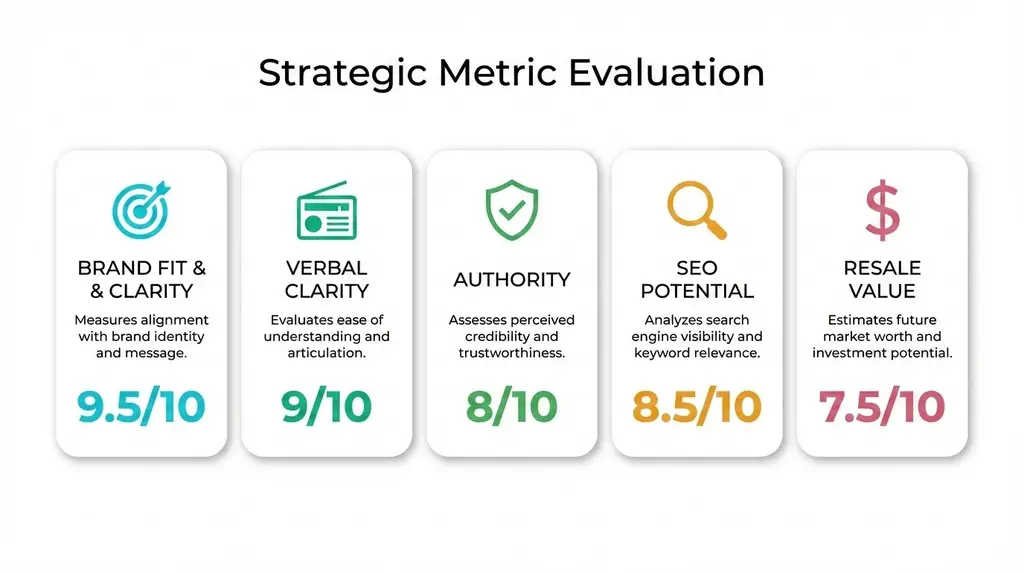
The result: URLGenie.ai ranked #1 out of 200+ candidates with a score of 98/100.
Here's how it broke down:
- Brand Fit & Clarity: 9.5/10 (clearly about URLs/domains, "Genie" suggests magic/instant results)
- Verbal Clarity: 9/10 (perfectly pronounceable, obvious spelling)
- Authority: 8/10 (.ai TLD is credible for AI tools, though .com would score higher)
- SEO Potential: 8.5/10 (unique, searchable, relevant keywords)
- Resale Value: 7.5/10 (short, memorable, growing .ai market)
We registered all of the top three names because the quality was so high. That's when we knew we'd built something special. The system worked so well for our own naming that we knew other founders needed it.
The Automated Alternative
Manually scoring domains using this framework is valuable—it forces you to think critically about what makes a good name. But it's also slow, subjective, and limited.
That's why we automated it.
URLGenie runs this exact five-factor analysis on every domain it generates. But instead of you manually scoring 50 names in a spreadsheet over several hours (and fighting your own biases), the system:
- Generates ~50 brandable domain ideas in one session (not keyword mashups)
- Checks real availability across multiple TLDs (.com, .ai, .io, .app, etc.) with pricing
- Scores every domain using the five brand signals with consistent, objective criteria
- Ranks the results so you focus on the strongest candidates
- Flags early risk signals like confusingly similar businesses or trademark issues
- Delivers an Executive Report with clear recommendations
Time required: ~5 minutes instead of 5 days.
The scoring is consistent because it's algorithmic. There's no "I'm tired so this name only gets a 6" bias. The system evaluates "DomainA" the same way it evaluates "DomainZ"—objectively, based on proven brand principles.
And because it automates the research phase (availability checks, similar business scans, pricing lookup), you're not wasting hours Googling domains one by one only to find out they're taken or surrounded by risky associations.
Try It Yourself
You now have the exact framework professional branding agencies use to evaluate domain names. You can apply it manually with the scoring table above—it genuinely works.
But if you want to evaluate dozens of names quickly, objectively, and with real data backing each score, try URLGenie. It's the same system we built to name ourselves, and it delivers ranked, scored results with risk analysis in under five minutes.
Your domain name is one of your most important brand decisions. Don't gamble on gut feeling. Use data, use a framework, and make sure you're picking a name that will actually work—not just one that sounds good in your head.