
Every founder loves free tools. I get it - when I was building my domain naming tool, I wanted it to be free too. A generous free tier felt like the right move for an early-stage product trying to win users.
Then I ran the numbers. The math was brutal.

This post is the honest story of why I charge $9.99 instead of offering unlimited free sessions. Not a sales pitch - just transparency about the real costs that most domain tools hide from you.
The Hidden Cost Every Time You Click "Check Availability"
When you type a domain name into a registrar's search box, something invisible happens: an API call fires off to check whether that domain is actually available.
That API call costs money. Every single time.
Domain availability APIs charge per query. The exact pricing varies by provider and volume, but here's what the industry looks like:
- Basic WHOIS APIs: $0.001 - $0.005 per lookup
- Premium availability APIs (with pricing data): $0.005 - $0.01 per lookup
- Multi-TLD bulk checks: Often $0.01+ per domain checked
These numbers look tiny. A fraction of a cent per query - who cares?
But here's what happens inside a tool like mine. Each brainstorm session generates approximately 50 brandable domain suggestions. For each suggestion, we check availability across multiple TLDs - not just .com, but .ai, .io, .app, and other relevant extensions.
That's potentially 200-300 API calls per session. At $0.005 per call, a single brainstorm costs $1-1.50 in domain API fees alone.
Now multiply that by thousands of users. The economics become impossible to sustain with a free model.
The AI Layer Adds Another Cost
Domain availability checking is just one layer. A proper naming tool doesn't simply check if domains are available - it generates brandable name suggestions using AI, then scores them across metrics, then analyses them for risk signals.
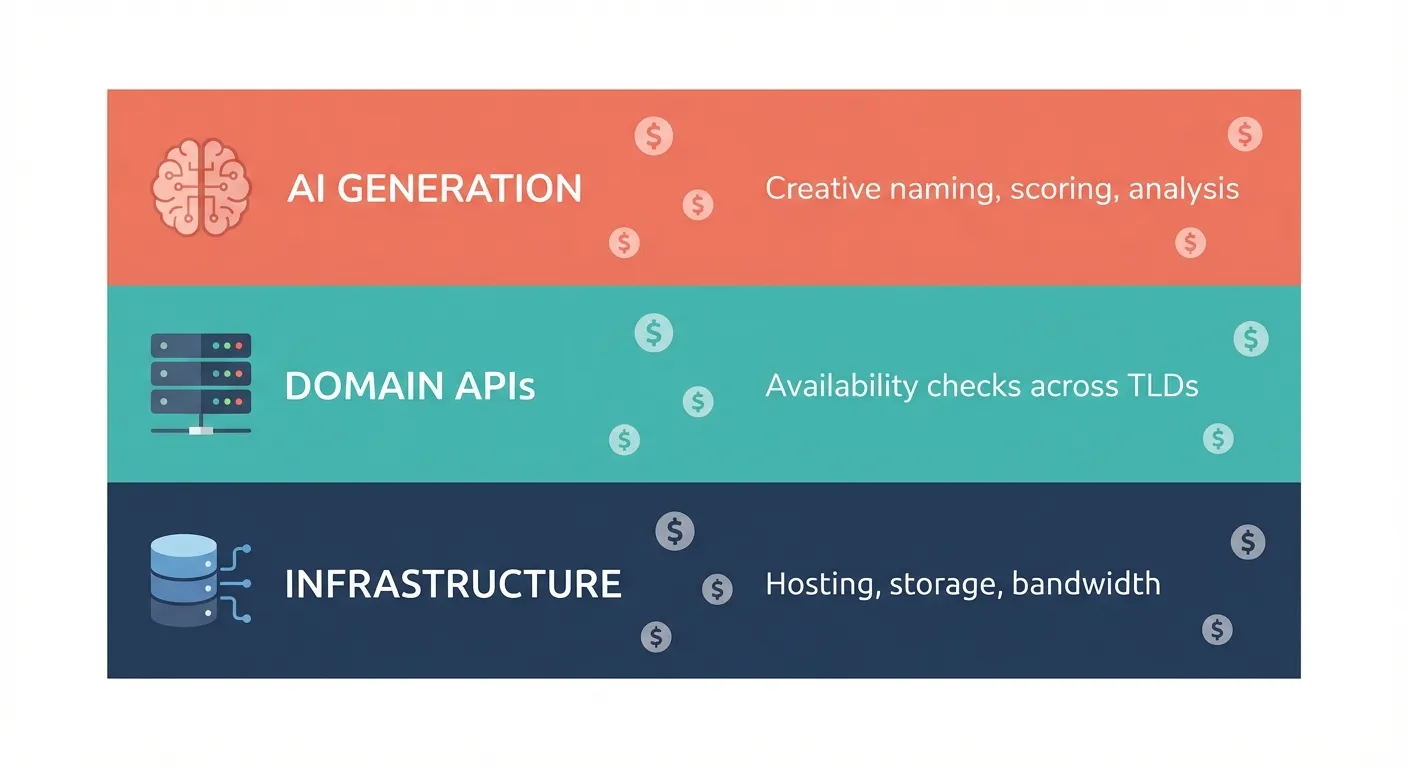
Each of these steps consumes AI tokens. Modern LLM APIs charge per token processed:
- Input tokens (your business description, context): $1-5 per million tokens
- Output tokens (generated names, scores, analysis): $5-25 per million tokens
A typical session processes thousands of tokens across multiple AI calls. The creative brainstorming alone requires substantial context to generate genuinely useful suggestions - not keyword mashups, but brandable names that match your business personality.
Add the scoring analysis. Add the risk scanning. Add the executive summary. The AI costs stack up quickly.
Why We Didn't Build a Trademark Database
One question I got asked early on: "Why doesn't the tool connect to actual trademark databases?"
I seriously considered it. A real trademark search would make the risk analysis more authoritative. But when I investigated what this would actually require, the scope was enormous.
Trademarks are registered country by country. The USPTO covers the United States. The EUIPO covers the European Union. But there's also:
- National trademark offices in every country
- Regional trademark systems
- Industry-specific registrations
- Common law trademarks (which aren't registered anywhere)
To build comprehensive trademark coverage, you'd need to integrate with hundreds of different systems, each with its own API (if they even have one), data format, and access requirements. Some charge substantial fees. Some require legal agreements. Some don't offer programmatic access at all.
The extra benefit during the ideation phase? Marginal.
At the brainstorming stage, you're generating dozens of name candidates. You're not ready to file a trademark application - you're exploring possibilities. Running every candidate through a comprehensive global trademark search would be slow, expensive, and mostly unnecessary.
I took a more practical approach: using web searches to flag prior usage and existing businesses with similar names. It's not a legal trademark opinion, but it catches the obvious conflicts early - before you invest time falling in love with a name that's already taken.
When you narrow down to a final shortlist, that's when formal trademark searching makes sense. And we tell users exactly that.
The Freemium Math Doesn't Work
I've read the SaaS playbooks. Freemium is supposed to be the growth strategy: give away the product for free, convert a small percentage to paid, and the paying users subsidise the free ones.
The problem is that freemium works best when the marginal cost of a free user is near zero. Email tools, project management apps, note-taking software - the infrastructure cost of one more free user is negligible.
Domain naming tools have the opposite economics. Every action has a marginal cost.
- User checks a name: API cost
- User generates suggestions: AI cost
- User runs another session: both costs again
The conversion rates required to make this work are unrealistic. Industry data suggests that only about 4% of free users convert to paid. If 96% of your users cost you money with zero revenue, the math doesn't close.
Some tools hide this by providing lower quality - cached results instead of live lookups, limited TLDs, no AI analysis. But that defeats the purpose. The whole point of finding available domains is getting accurate, current information.
What This Means For You
I could have built a free tool. It would have meant:
- Rate limiting everything: Tiny daily allowances that frustrate users
- Skimping on coverage: Only checking .com, not .ai, .io, and other TLDs
- Cutting the AI analysis: Basic availability checking without scoring or risk signals
- Showing ads: Monetising through interruption instead of value
- Selling data: Your business ideas becoming someone else's product
Instead, I charge $9.99 for five complete sessions. Each session gives you:
- ~50 AI-generated brandable suggestions
- Real availability checking across multiple TLDs
- Full scoring across five brand metrics
- Risk signal analysis
- A clear executive summary
That's approximately 250 domain name candidates with complete analysis. At the API costs involved, this is already a thin-margin proposition.
The Comparison That Matters
Here's the other way to think about it: what's your time worth?
The manual approach to domain naming looks like this:
- Brainstorm names in a spreadsheet (hours)
- Check each one individually at registrars (hours more)
- Research each candidate for trademark conflicts (hours more)
- Try to objectively score them without a framework (frustrating)
- Make a decision without confidence (stressful)
Branding agencies charge $5,000 to $50,000 for naming projects. They're selling expertise, but they're also selling the time savings of not doing it yourself.
URLGenie delivers most of that value for $9.99. The API costs are real, but they're a fraction of what you'd pay for professional help - or what your time is worth if you do it manually.
The Honest Trade-Off
I built this tool because I needed it. When I was naming another project, I spent days on the manual process and wished for something better. The tool exists because the problem is real.

Charging for it isn't a choice I made enthusiastically. Free would grow faster. Free would feel more generous. But free would also mean compromising on quality, accuracy, or sustainability - and that's not a trade-off I'm willing to make.
The $9.99 price point covers the real costs while keeping the tool accessible to founders who need it. If you use all five sessions, you're paying about $2 per complete naming analysis. If you find one good domain name, that's a bargain.
If the tool doesn't help you find a domain you love, there's a refund policy. The risk is on me, not you.
What I Learned About Pricing Transparency
Building this as a side project (my main work is running Tech Camp UK, teaching kids about technology and engineering) gave me the freedom to be honest about pricing. There's no VC pressure to grow at all costs, no board demanding a free tier that bleeds money.
Just a founder trying to build something useful and sustainable.
The experience has actually inspired me to add a "Vibe coding" course to the camp curriculum - showing kids how to build apps and businesses from their ideas. Part of that lesson is understanding real costs and making honest pricing decisions.
Not everything valuable can be free. And the things that pretend to be free usually extract value in ways you don't see.
I charge because the alternative is worse for everyone.